Summer 2026 (Volume 36, Number 2)
The CRA's 2026 Distinguished Rheumatologist: Dr. Evelyn Sutton
Download PDF
Why did you become a rheumatologist? What or who influenced you along the way to do so?
I was a PGY3 and uncertain what path to take, when a rotation in Saint John, New Brunswick, under Drs. Virender Khanna and Eric Grant changed everything. I was captivated by the breadth and depth of the specialty, but even more so by the patients. Their stoicism, their understated expression of suffering, and their resilience convinced me that these were the people I wanted to serve.
You have held numerous leadership roles, including serving as President of the Canadian Rheumatology Association (2020–2022) and as Division Head of Rheumatology and Director of the Nova Scotia Arthritis Centre at Dalhousie University (2004–2015). You’ve also made lasting contributions to medical education, including developing a nationally recognized elective for senior residents and serving nearly two decades in the Deanery.
You have been an active CRA member throughout your career, contributing to numerous resident pre-courses, chairing both the Annual Resident Review Course and the Annual Scientific Planning Committee, and fostering strong relationships between the CRA and the Arthritis Society. You’ve been deeply involved in building partnerships, and you served a decade on the Arthritis Society’s Board.
a) Across your leadership roles, what has been one of the most significant professional or organizational challenges you’ve faced, and how did you navigate it?
When I joined the Board of the Canadian Rheumatology Association, I was determined to restore constructive relations with the Arthritis Society. Historically, these organizations had worked closely together. The Arthritis Society—originally founded as the Canadian Arthritis and Rheumatism Society (renamed in 1977)—and the Canadian Rheumatism Association collaborated to advance rheumatology as a specialty. Notably, in the 1960s they jointly established Rheumatic Disease Units (RDUs) across Canada, supported residency training positions, and helped create the Canadian Council of Academic Rheumatologists (CCAR).
By the late 1980s, however, this collaborative legacy had eroded. As a young rheumatologist, I was struck by the degree of mistrust and open discord at annual meetings—at times escalating into shouting matches. By the time I joined the CRA Board, I had also served the Arthritis Society in both committee and Board roles. It became clear to me that, while the two organizations shared fundamentally aligned goals, they often held unrealistic expectations of one another’s roles and capacities. This misalignment fostered misunderstanding, mistrust, and lingering resentment.
To address this, I advocated to both Boards for a more formalized and structured relationship. Fortunately, this proposal was supported. As a result, the Past President of the CRA now holds a position on the Arthritis Society Board. Today, when national issues affecting patient care arise, the Arthritis Society and the CRA collaborate closely to develop coordinated and effective action plans.
Recognized with multiple honours, including the 2014 CRA Teacher-Educator Award and a Certificate of Excellence from the Canadian Association for Medical Education. Your book, A Primer on Musculoskeletal Examination, underscores your lasting influence on training future medical learners.
a) In your view, what are the qualities of an excellent teacher?
Over the years, I’ve come to realize that what matters most is not just what we know, but how we share it—how we make space for questions, how we encourage thinking, and how we support growth.
Some of the best teachers I’ve known had a remarkable ability to take something complex and make it clear—not by simplifying it too much, but by organizing it in a way that made sense. They asked thoughtful questions, not to test, but to guide. They gave feedback that was honest but constructive. And perhaps, most importantly, they created an environment where it felt safe to say, “I don’t understand,” or even, “I made a mistake.”
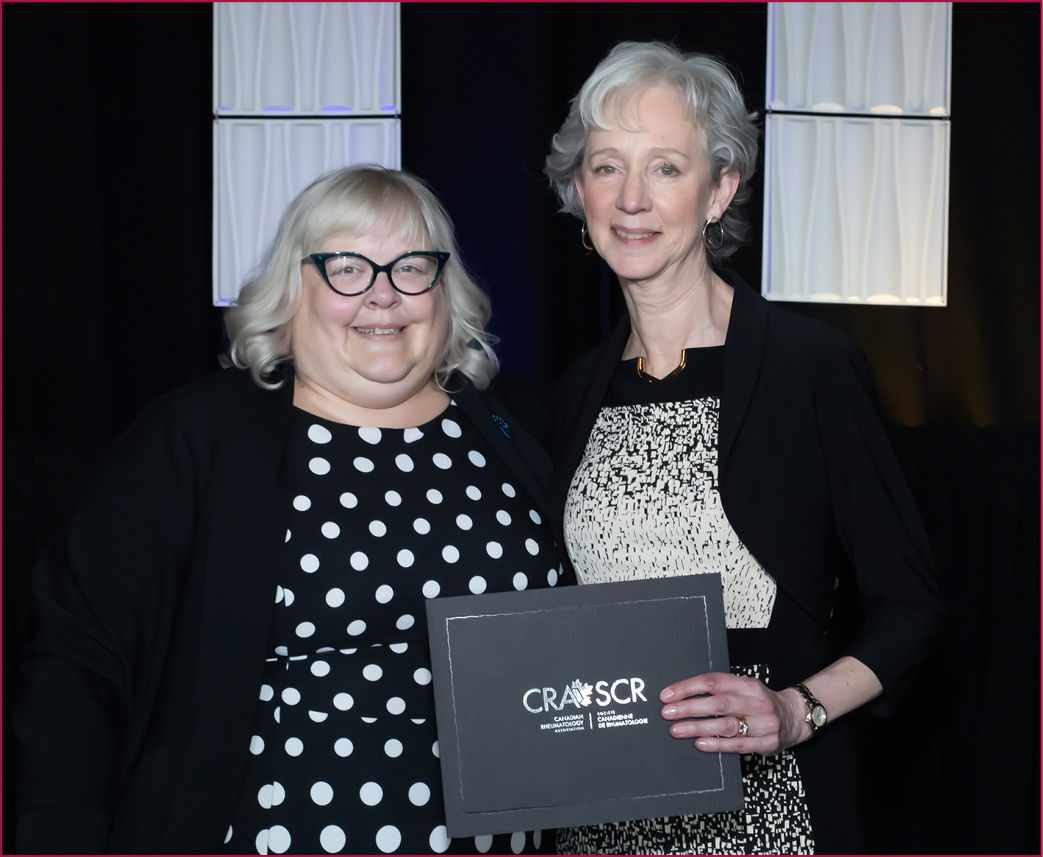
Dr. Evelyn Sutton receiving her award from then-CRA President
Dr. Trudy Taylor at
the CRA Annual Scientific Meeting in
Halifax, which took place in April 2026.
From where did your passion and interest in rheumatology stem?
My interest in rheumatology really took shape during residency. I found myself drawn to the complexity of the diseases—the way they cross multiple systems and often present as diagnostic puzzles that require careful thought and patience. I enjoyed that intellectual challenge, but what truly stayed with me were the patients.
Many were living with chronic pain and significant disability, yet they carried themselves with remarkable resilience. They rarely complained, and there was a quiet dignity in how they managed their illness day to day. I found that deeply moving. Over time, I realized it was not just the science of rheumatology that appealed to me, but the privilege of caring for this particular group of patients. That combination made the decision feel less like a choice and more like a calling.
What is the professional accomplishment of which you are proudest to date?
In the early 2000s, I recognized a gap in care for our systemic sclerosis patients who developed pulmonary arterial hypertension. I met with the Division Heads of Respirology and Cardiology to seek their support in approaching members of their divisions to establish a shared-care clinic. I also met with hospital administrators and presented a budget demonstrating that a dedicated program could reduce costs by decreasing hospital admissions and length of stay. In addition, I approached industry partners for support in developing a clinical database. After two years of planning, the QEII Health Sciences Centre Pulmonary Arterial Hypertension Program was launched in 2007. It remains a multidisciplinary initiative, and although I am no longer directly involved in the clinic, I am proud that it continues to thrive and is recognized as a program of excellence.
Evelyn Sutton, MD, FRCPC
Professor of Medicine,
Dalhousie University
|
-EN-v2.gif)


-EN-v1.gif)