Summer 2026 (Volume 36, Number 2)
Celebrating the 20th Anniversary
of ACPAC
By Julie Herrington, PT, MSc, ACPAC; Michael Denton, PT, MScPT, ACPAC;
Michelle Bridge, OT Reg. (Ont.), ACPAC; Laura Passalent, PT, MHSc, ACPAC;
and Leslie Soever, PT, MSc, ACPAC
Download PDF

The Origins
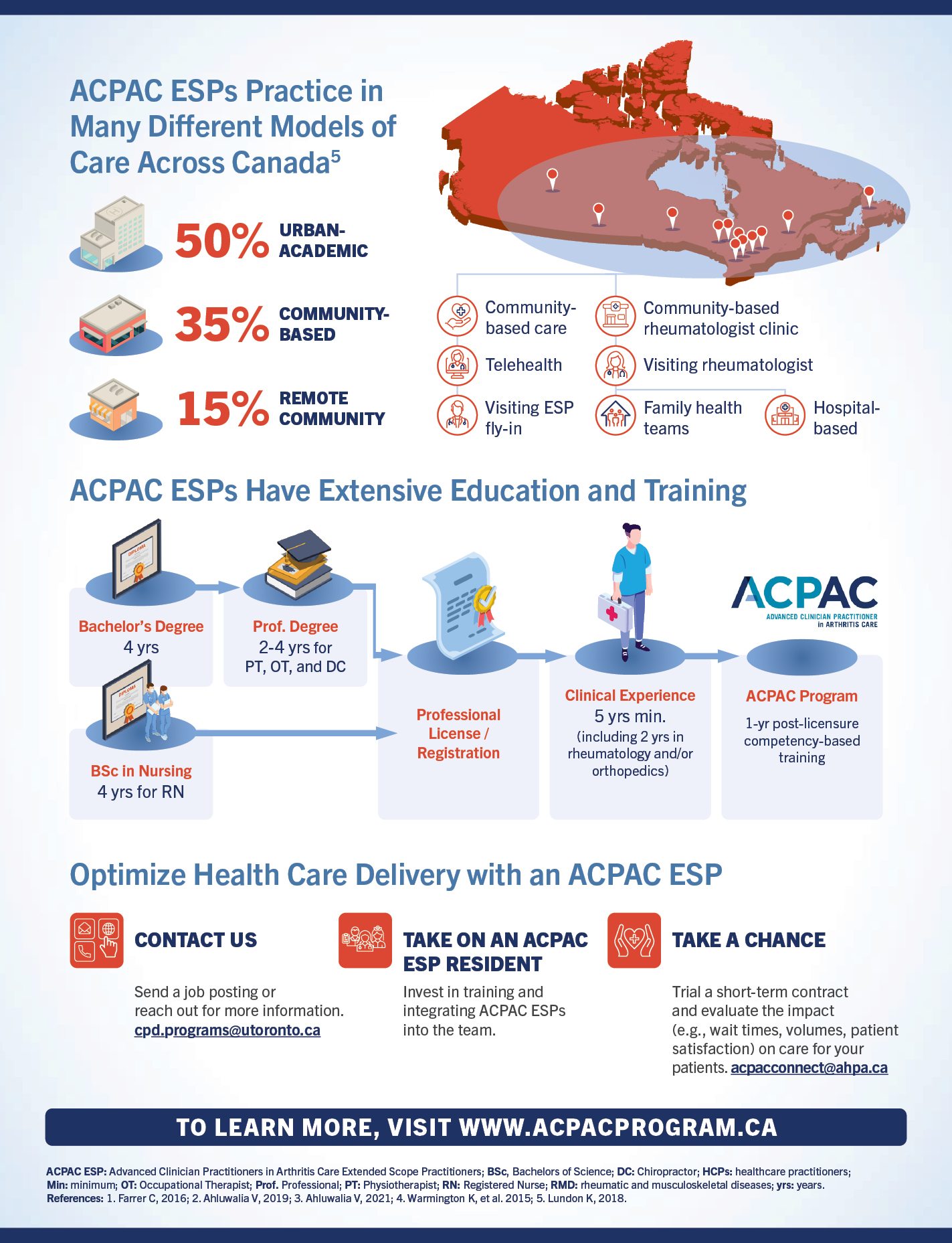
The Advanced Clinician Practitioner in Arthritis Care (ACPAC) program is now in its 20th year, having graduated 140 clinicians with 12 currently in training. This program was modeled on a 1996 SickKids initiative by Dr. Ron Laxer that leveraged team expertise by uptraining a physiotherapist to share the pediatric clinical caseload.1 In 2005-06, modelled on the SickKids endeavour, rheumatologist Dr. Rachel Shupak and physiotherapist Dr. Katie Lundon expanded the concept, creating the ACPAC program.2 It is a rigorous, competency-based, university-affiliated, educational program to train experienced physiotherapists, occupational therapists, nurses and chiropractors for extended scope practice roles across a broad range of rheumatic and musculoskeletal diseases (RMDs). Upon the retirement of Drs. Shupak and Lundon, in 2020, leadership transitioned to Canadian Rheumatology Association (CRA) members Drs. Amanda Steiman, Rob Inman and Deborah Levy; along with ACPAC graduates Laura Passalent and Leslie Soever; and orthopedic surgeon Dr. Christopher Nielsen.
How are ACPAC practitioners contributing to rheumatology care?
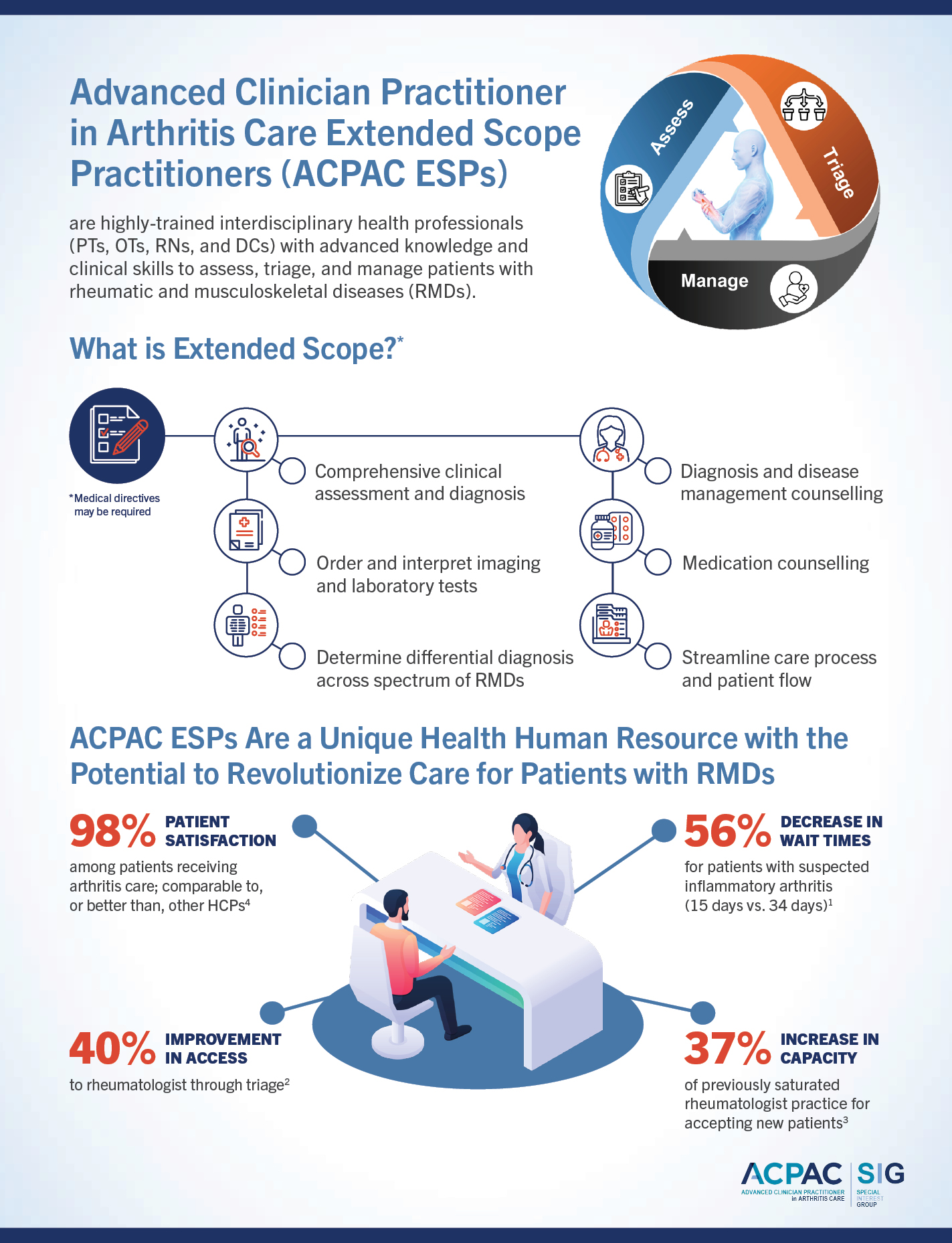
ACPAC practitioners work in models of care performing duties beyond their traditional professional scope of practice. A newly created infographic defines the extended scope tasks ACPAC clinicians undertake in various roles. Dr. Vandana Ahluwalia, an early adopter of these models of care, led investigations that have demonstrated improved system metrics when integrating ACPAC practitioners into rheumatology care.3 A recent scoping review describing the contributions to peer-reviewed literature by ACPAC practitioners and the ACPAC program found 106 articles published up until June 2023, primarily in rheumatology journals (38%), most often focusing on the impact of models of care (23%), with 86% of articles including an ACPAC graduate as an author.4 Evidence of successful implementation of these models of care in other settings including rural care, transition clinics and pediatric environments is also growing rapidly.5-7
The ACPAC Community
Over the past seven years, ACPAC alumni have formalized as the ACPAC Special Interest Group (SIG) within the Arthritis Health Professions Association (AHPA). The ACPAC SIG provides targeted ongoing professional development in the form of education, research support, leadership opportunities and advocacy for this growing health human resource. A 2023 survey (n=67) characterized the working ACPAC community as 85% physiotherapists, with the majority working in Ontario in Rapid Access Clinics (39%), community rheumatology clinics (22%) and ambulatory hospital settings (22%).8 The literature has seldom investigated the motivations or experiences of extended scope practitioners; however 65% of ACPAC SIG members indicated they are very or extremely satisfied with the roles they fill. Reasons for satisfaction include opportunities for collaboration with other medical professionals; having a positive impact on patient/family care, and the ability to engage in research, leadership, and education.8
ACPAC Clinicians are a Unique Health Human Resource
The ACPAC program celebrates its 20th anniversary with the graduation of the 2025-2026 cohort this June. The CRA ASM in Halifax in April 2026 marked our largest ever attendance of ACPAC practitioners (19), with four having presented workshops, three having presented posters, one having participated in RheumJeopardy! and many others contributing as poster authors. The ACPAC community is growing, offering workforce solutions in rheumatology and becoming strong advocates for improving the quality of rheumatology care in Canada.
Interested?
Consider taking an ACPAC resident for some of their required training hours. Reach out to the ACPAC SIG at acpacconnect@ahpa.ca for more information regarding how to integrate ACPAC-trained clinicians into rheumatology care.
Julie Herrington, PT, MSc, ACPAC
ACPAC SIG Past Chair, Advocacy Lead
Michael Denton, PT, MScPT, ACPAC
ACPAC SIG Chair, Orthopedic Lead
Michelle Bridge, OT Reg. (Ont.), ACPAC
Past President, Arthritis Health Professions Association
Laura Passalent, PT, MHSc, ACPAC
Co-Director, ACPAC Program
Leslie Soever, PT, MSc, ACPAC
Co-Director, ACPAC Program
References:
1. Campos A, Graveline C, Ferguson J. The physical therapy practitioner: An expanded role for physical therapy in pediatric rheumatology. Physiotherapy Canada. 2001;3:282-6.
2. Lundon K, Shupak R, Canzian S, et al. Don't let up: implementing and sustaining change in a new post-licensure education model for developing extended role practitioners involved in arthritis care. J Multidiscip Healthc. 2015;8:389-95.
3. Ahluwalia V, Inrig T, Larsen T, et al. An Advanced Clinician Practitioner in Arthritis Care (ACPAC) Maintains a Positive Patient Experience While Increasing Capacity in Rheumatology Community Care. J Multidiscip Healthc. 2021;14:1299-310.
4. Herrington J, Caldana L, Whitney K, et al. The Advanced Clinician Practitioner in Arthritis Care Contributions to the Scientific Literature: A Scoping Review. J Rheumatol. 2025;52(Suppl 2):1-92.
5. Dushnicky MJ, Har-Gil ES, Lee JJY, et al. Pediatric Rheumatology Care in the Canadian Context: A Qualitative Analysis of Care Providers. J Rheumatol. 2025;52(5):498-504.
6. Herrington J, Clarkin P, Singleton J, et al. A Canadian Advanced Physiotherapist Practitioner Shared-Care Model in Pediatric Rheumatology Offers Safe and Quality Care in the Management of Juvenile Idiopathic Arthritis-Comparing Key Performance Indicators with the PR-COIN Registry. Children (Basel). 2025;12(12).
7. Steiman A, Inrig T, Lundon K, et al. Telerheumatology Shared-Care Model: Leveraging the Expertise of an Advanced Clinician Practitioner in Arthritis Care (ACPAC)-Trained Extended Role Practitioner in Rural-Remote Ontario. J Rheumatol. 2024;51(9):913-9.
8. Denton M. ACPAC SIG Clinician Survey. 2023.
|
-EN-v2.gif)


-EN-v1.gif)