Summer 2026 (Volume 36, Number 2)
The CRA's 2026 Distinguished Investigator: Dr. Cheryl Barnabe
Download PDF
Why did you become a rheumatologist? What or who influenced you along the way to do so?
My career selection process was a lesson in how chance encounters and being open to new experiences can work out really well. I entered medical school with very little awareness of all the different specialties available and fully intended to specialize in rural family medicine. I was signed up to do a 4-month rural family medicine clinical summer studentship at the end of my first year of medical school, but the program was cancelled shortly before it was to start. I was instead offered a position in the Bachelor of Science in Medicine program to complete a needs assessment project for rural family medicine physicians on education in palliative care. I joined the inpatient palliative care team during their rounds and resident teaching sessions so that I could learn about that specialty to be able to design my data collection materials. I met a phenomenal nephrology resident rotating in palliative care, and she inspired me to consider a specialty, and I was particularly drawn to dermatology.
When it came time to selecting my internal medicine sub-specialty block, I decided on rheumatology thinking I would see many different skin manifestations of autoimmune diseases. At this time biologics were just starting to be offered in clinical care for rheumatoid arthritis (RA), so it was a very exciting time to see how impactful effective treatment could be for patient outcomes. The academic rheumatologists at the University of Manitoba were highly supportive of me and engaged me in their research as I completed the rest of medical school. I think they may have paid a bribe to the Canadian Resident Matching Service (CaRMS), and so I remained in Winnipeg for internal medicine. I found every other internal medicine specialty to be monotonous, so it became very clear that rheumatology was the specialty for me. Research remained a strong interest during my training, and I saw it as providing the opportunity to more fully understand a disease process or why different outcomes occur. It also offers the chance to intervene to improve those outcomes for a much broader population than just those in your practice. I then completed both residency and a Masters degree at the University of Calgary before joining the faculty of the Cumming School of Medicine as a clinician scientist.
What do you believe are the qualities of a distinguished investigator and rheumatologist, particularly in the context of advancing health equity and community-engaged research?
Investigators are naturally curious and need to simultaneously gain a deep understanding of a problem while keeping an open mind to a broad range of approaches to arrive at solutions. It is impossible to do research without collaboration, so you also need to be skilled at developing relationships and building a network that is fun to work in. Always keeping the “why” of what you are doing close to the heart maintains the inspiration even when there are setbacks or challenges in the program of research. The solutions to advance health equity are complex with political factors and individual beliefs and biases to address, meaning there is no easy route to make change, so it also takes persistence. Community engaged research is highly rewarding but does require being flexible and patient, as priorities may shift as the community responds to other events and situations that arise.
What are some of your other passions outside of rheumatology and research?
My daughters have been involved in ringette and box lacrosse for a decade. The community supporting these female youth sports is phenomenal and seeing both girls gain confidence and maturity through their experience in sport has led me to want to give back. I have served in many volunteer roles as a result, including team manager, assistant coach, trainer, board member, association president, and as a member of the host committees for both the Canadian Ringette Championships in 2022 and the World Ringette Championships in 2023. If I’m not in a rink I am sewing in my garden, or at the lake.
You have taken on a research leadership position as Director of the McCaig Institute for Bone and Joint Health. What are the best aspects of that role?
I am really enjoying the role. I get to interact with scientists from orthopedics, engineering, kinesiology, veterinary medicine, cell biology, and imaging science working across a variety of musculoskeletal diseases. My job is to facilitate and promote their work, build collaborative networks in bone and joint health research, and interact with philanthropists. The Institute also hosts several public education events and conferences so there is also a creative aspect in the role.
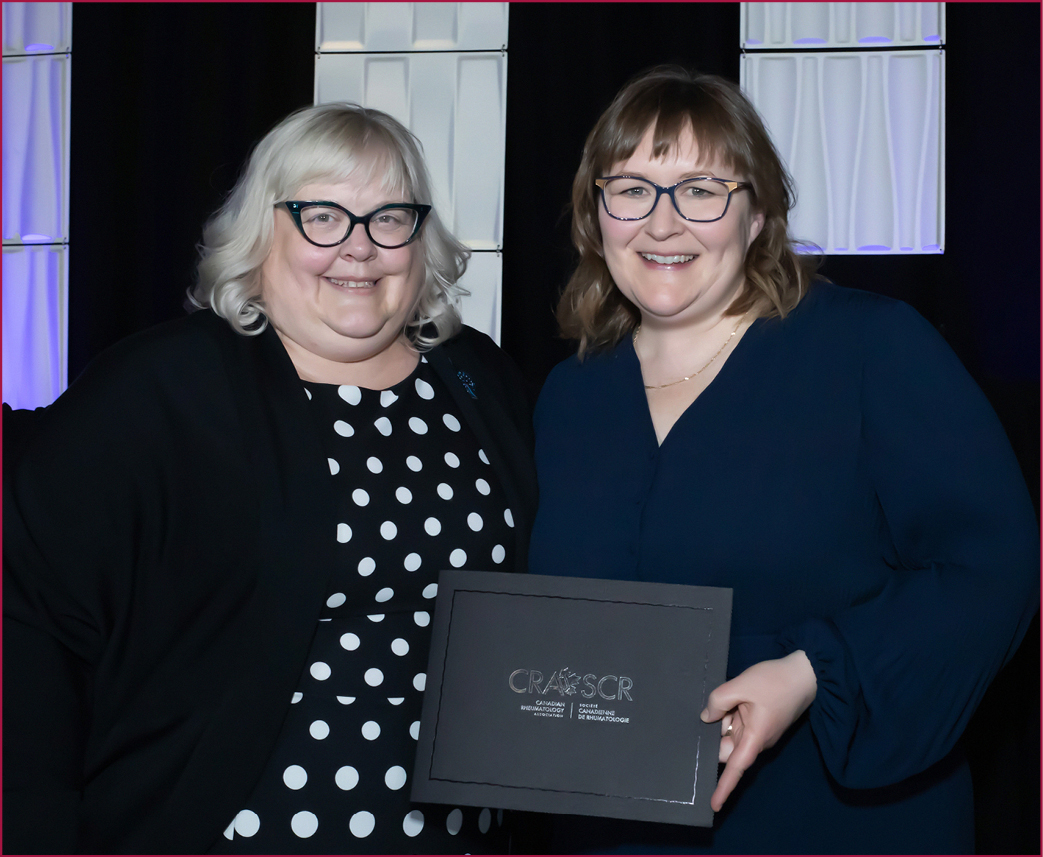
Dr. Cheryl Barnabe receiving her award from then-CRA President Dr. Trudy Taylor at
the CRA Annual Scientific Meeting in Halifax, which took place in April 2026.
Cheryl Barnabe, MD, FRCPC
Director,
McCaig Institute for Bone and Joint Health,
Cumming School of Medicine,
University of Calgary
Canada Research Chair,
Rheumatoid Arthritis and Autoimmune Diseases
Arthur JE Child Chair in Rheumatology Research,
Professor,
Departments of Medicine and Community Health Sciences
Rheumatologist, Alberta Health Services
|
-EN-v2.gif)

-EN-v1.gif)