Spring 2026 (Volume 36, Number 1)
Choosing Wisely: Survey Results
Aligning with Other Societies' Choosing
Wisely Statements
Download PDF
This edition’s Joint Count survey examined CRA members’ perspectives on Choosing Wisely guidelines from other specialties. The goal of the survey was to raise awareness in the rheumatology community about other societies’ recommendations that the Choosing Wisely Subcommittee found to be relevant to rheumatology. A total of 79 survey responses were submitted from nine of 10 provinces, and from both adult and pediatric rheumatologists.
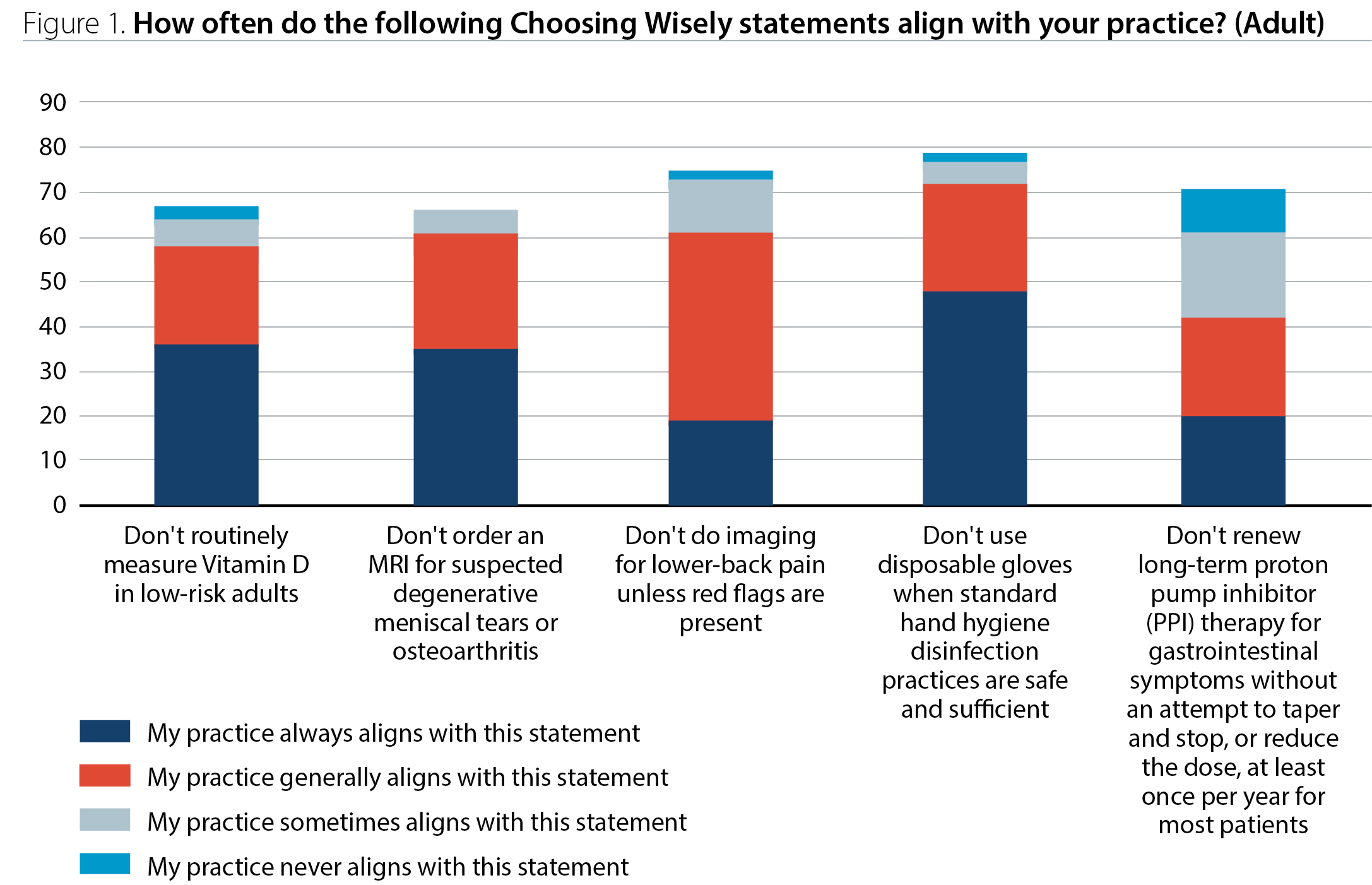
We asked, “How often do the following Choosing Wisely statements align with your practice,” and the results are shown in Figure 1. For several statements, most respondents reported that their practice always or generally aligned, including “don’t do imaging for lower-back pain unless red flags are present” (81.3%); “don’t routinely measure vitamin D levels in low-risk adults” (86.6%); “don’t order an MRI for suspected degenerative meniscal tears or osteoarthritis” (92.2%); and “don’t use disposable gloves when standard hand hygiene disinfection practices are safe and sufficient” (91.2%).
There was considerably more variability in the response rates for the statement “don’t renew long-term proton pump inhibitor (PPI) therapy for gastrointestinal symptoms without an attempt to taper and stop, or reduce the dose, at least once per year for most patients” (58.3%). While generally safe and effective, PPIs are often prescribed for a longer duration or at a higher dose than guidelines recommend (reference 1). It is recommended to optimize PPI use by prescribing them only when indicated, using the recommended dose and duration, and deprescribing when unnecessary. Deprescribing PPIs could lead to lower risk of side effects like lower calcium absorption and osteoporosis, polypharmacy, reduce environmental impact, and cost savings. Choosing Wisely Canada has created a toolkit for PPI prescribing/ deprescribing (link: https://choosingwiselycanada.org/wp-content/uploads/dlm_uploads/2025/07/CWC_Toolkit_AskWhyPPI_2025.pdf).
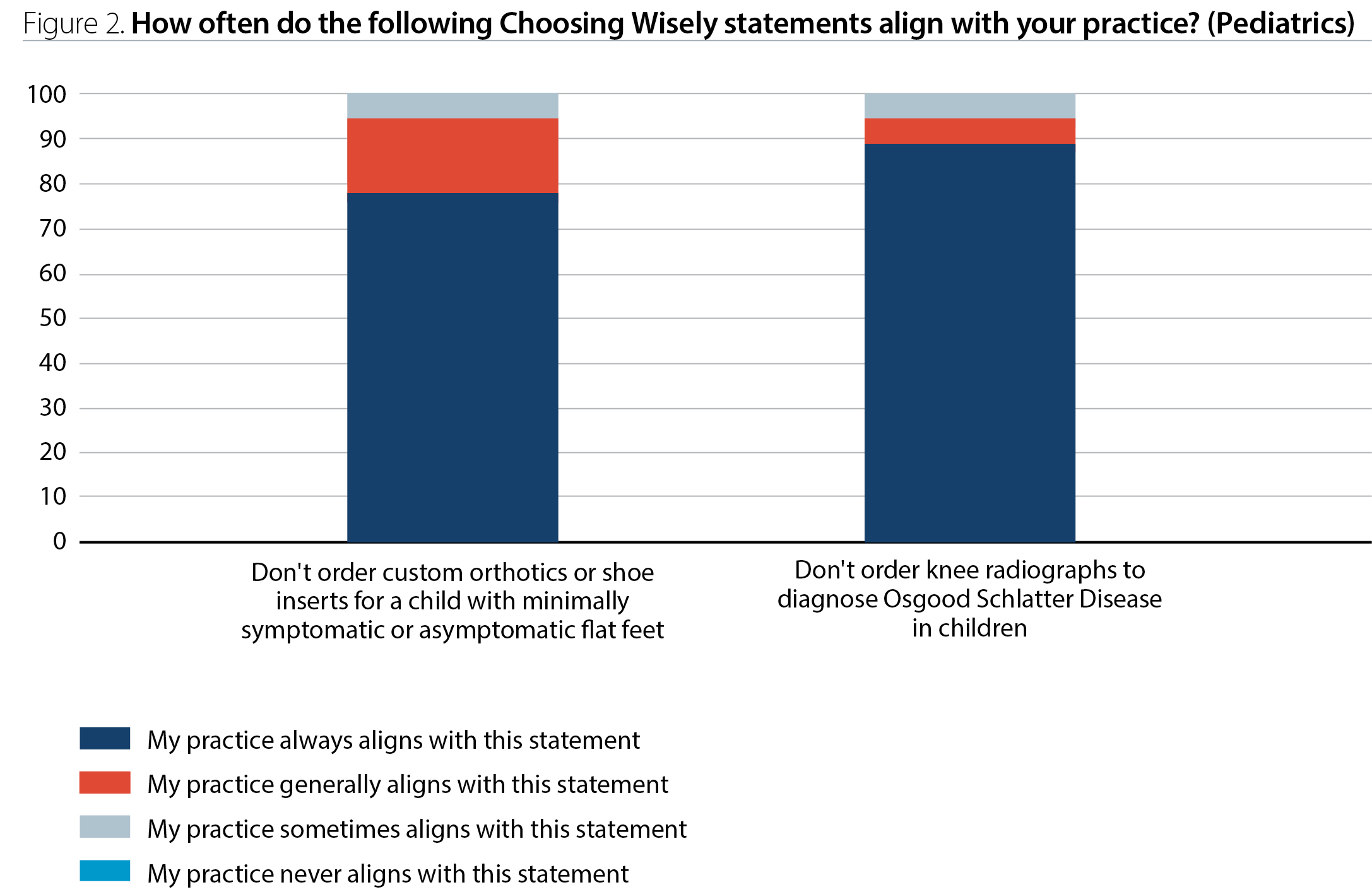
Regarding the pediatric-specific recommendations, the bulk of respondents agreed that they do not “order custom orthotics or shoe inserts for a child with minimally symptomatic or asymptomatic flat feet” (94.4%) and “don’t order knee radiographs to diagnose Osgood Schlatter Disease in children” (94.4%), though the overall numbers of respondents for whom these statements were relevant was low (17). See Figure 2 for further details.
General comments centered around ensuring that the guidelines are not applied in an overly broad fashion, highlighting that some rheumatology patients may not be the target population of these statements. It was also astutely pointed out that “It would be good to have a mechanism that resulted in behaviour change. As statements, the Choosing Wisely list is more advisory than actionable.” We look forward to continuing to disseminate information from the Choosing Wisely guidelines while looking at mechanisms to help implement them for applicable populations in rheumatology practices across Canada. For any questions or feedback, please reach out to info@rheum.ca.
Reference:
Choosing Wisely Canada. “Ask Why for PPIs” https://choosingwiselycanada.org/wp-content/uploads/dlm_uploads/2025/07/CWC_Toolkit_AskWhyPPI_2025.pdf. Accessed January 28, 2026.
|
-EN-v2.gif)


-EN-v1.gif)