Spring 2026 (Volume 36, Number 1)
Springing Forward Together: Sustainability in Rheumatology
By Stephanie Tom, MD, FRCPC, on behalf of the CRA Planetary Health Taskforce
Download PDF

The Canadian Rheumatology Association (CRA) Planetary Health Taskforce was launched in 2024, with taskforce members including Drs. Philip Baer, Claire Barber, Sasha Bernatsky, Molly Dushnicky, Beth Hazel, Fergus To and Stephanie Tom (Chair). We launched a bilingual sustainability toolkit in spring 2025 after input from additional rheumatologists, allied health professionals and patient groups, with over 500 toolkit downloads in the first 9 months. In fall 2025, we circulated Around the Rheum podcasts in both English and French. In the past year, we have accumulated thousands of impressions on the CRA’s LinkedIn and X social media accounts.
We’ve shared our work through REACTRheum, the Canadian Coalition for Green Healthcare, the Canadian Association of Physicians for the Environment, the CASCADES network, the Royal College of Physicians and Surgeons of Canada, multiple university rounds, the Australian Rheumatology Association, the American College of Rheumatology, and Choosing Wisely conferences in Winnipeg (2025) and in Toronto (2026). We are grateful to the CRA for its support and communication assistance, as well as grants from the Royal College Foundation and Choosing Wisely Canada. To wrap up our taskforce activities for 2026, we’re launching RheumBingo! as a gamification tool to implement the top actionable steps in rheumatology offices to reduce our own carbon footprint.
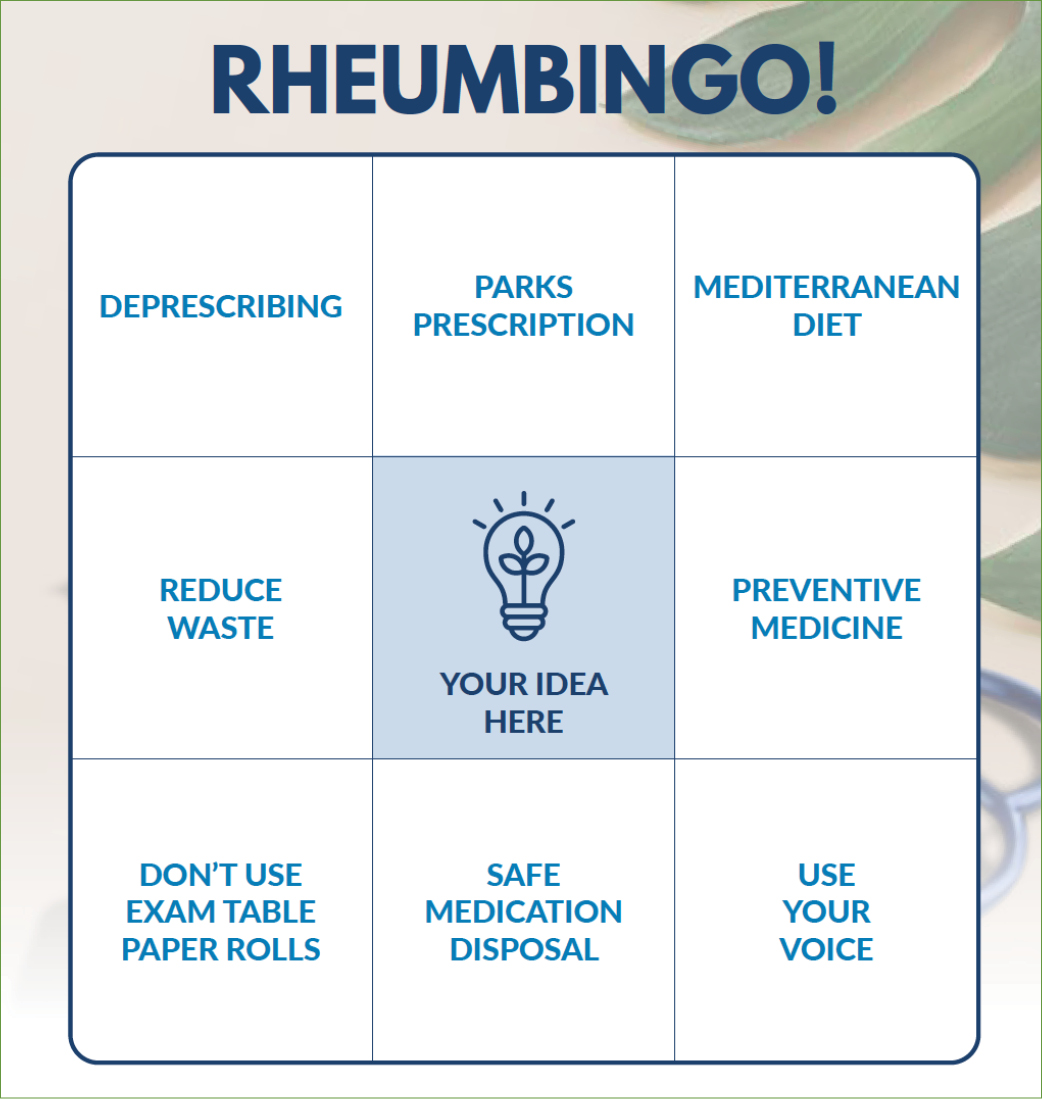
Inspired by our annual scientific meeting’s RheumJeopardy, points will be awarded to Team West or Team East. Teams will be evenly matched, with Ontario serving as the dividing line. The West includes London, Kitchener, Waterloo, Guelph, Hamilton and westward, and the East includes Oakville, Mississauga, Toronto and eastward. The point categories are Gold (9/9 tasks below completed; worth 3 points), Silver (6-8 tasks/2 points) and Bronze (4-5 tasks/1 point). This is a self-reporting event, and points are awarded per CRA member. Thus, if a team of 3 rheumatologists in a shared clinic all participate, you receive triple the points for your team. For submissions and further questions, you can reach out to info@rheum.ca.
1. Deprescribing: Two-thirds of the healthcare sector’s carbon footprint is related to the supply chain, which involves the medications and equipment we use. By reducing polypharmacy, we also chip away at the life cycle of manufacturing, transportation, utilization and disposal of products (e.g. taper advanced therapies when clinically appropriate with shared decision-making with patients or reduce unnecessary lab testing).1,2,3
2. Reduce waste: Most medical waste can be safely sent to landfills, though anything considered biohazardous must be incinerated, which results in higher carbon emission compared to landfills.4 By ensuring proper sorting at the user level, we reduce clinic costs for waste disposal (e.g., hand hygiene over gloves in certain clinical contexts where there are no infection control concerns or invasive procedures). Encourage patients to bring their own suitable clothing for physical examinations.
3. Safe medication disposal: Medications sent to landfills or flushed down toilets end up in groundwater and other sources. You can direct patients to return unused medications to their pharmacies for safe disposal.5
4. Preventative medicine: Smoking cessation (due to the link between cigarette smoking and autoimmune disease flares) and recommending vaccines (i.e., seasonal flu vaccines) could reduce risks of hospitalizations and ER visits.6
5. Exercise or nature prescribing: Encouraging physical activity (based on patient interests, access and disease status) improves function.7 Any healthcare provider (physician, nurse, occupational or physiotherapist) can prescribe one free Parks Canada pass monthly via the PaRx program.8
6. Don’t use exam table paper rolls: Evidence shows that high touch surfaces are the sides of the table.9 If surfaces need to be sanitized, consider washable cloths and 70%+ ethyl or isopropyl alcohol-based solutions.10
7. Mediterranean diet and plant-forward options: There is evidence that the Mediterranean diet improves autoimmune diseases and cardiovascular health. Plant-forward diets generally have a much lower carbon footprint than diets high in red meat. Diet options should recognize cultural diversity, costs, and travel distances of food supplies.11,12
8. Use your voice: Advocate for green supplier options; mention the importance of reduced single use plastics and less packaging for medication (there is a preliminary study from France that indicates prefilled syringes have much lower emission costs than autoinjectors); check out workshops or consider QI projects on the impact (planetary and/or cost) of environmental changes.13,14
9. Insert your idea here! Pick an idea of your choice and tell us what you did. For further ideas, check out the CRA sustainability toolkit https://rheum.ca/resources/planetary-health-for-rheumatology/ (English) or https://rheum.ca/fr/resources/la-sante-planetaire-et-la-rhumatologie/ (French).
Stephanie Tom, MD, FRCPC
Vice-President, Canadian Rheumatology Association (CRA)
Chair, CRA Planetary Health Task Force
Trillium Health Partners
Mississauga, Ontario
References:
1. Tennison I, Roschnik S, Ashby B, et al. Health care's response to climate change: a carbon footprint assessment of the NHS in England. Lancet Planet Health. 2021;5(2):e84-e92.
2. Hazlewood G, Jung M, Kaminska E, et al. One-Year Outcomes After Decision Aid-Led Tapering of Advanced Therapy in Rheumatoid Arthritis. Journal of Rheumatology. 2025;52(2):26-27.
3. Ulijn E, den Broeder N, Bevers K, et al. Long-Term Routine Laboratory Toxicity Monitoring of Immunomodulatory Drugs in Rheumatoid Arthritis: A Retrospective Cohort Study. Annals of Internal Medicine. 2025;178(10):1400-1408.
4. Duong D. Improper disposal of medical waste costs health systems and the environment. CMAJ. 2023:195(14):E518-519.
5. Health Products Stewardship Association. Available at healthsteward.ca. Accessed January 24, 2026.
6. Bass A, Chakravarty E, Akl E, et al. 2022 American College of Rheumatology Guideline for Vaccinations in Patients With Rheumatic and Musculoskeletal Diseases. Arthritis Care & Research. 2023;75(3):449-464.
7. Andonian B and Lassell R. Physical Activity for Human and Planetary Health: Incorporating Green Exercise in the Management of Rheumatic Disease. Rheumatic Disease Clinics of North America. 2026;52(1):163-180.
8. PaRx. Available at https://www.parkprescriptions.ca/en-ca. Accessed January 24, 2026.
9. Chiarlitti N, Graves Z, Lavoie C, Reid RER. Does Examination Table Paper Use Mitigate the Risk of Disease Transmission in a Family Medicine Clinic? Ann Fam Med. 2024;22(3):230-232.
10. Public Health Ontario Infection Prevention and Control for Clinical Office Practice. 2015. Available at https://www.publichealthontario.ca/-/media/documents/B/2013/bp-clinical-office-practice.pdf. Accessed January 24, 2026.
11. England B, Smith B, Baker N, et al. 2022 American College of Rheumatology Guideline for Exercise, Rehabilitation, Diet, and Additional Integrative Interventions for Rheumatoid Arthritis. Arthritis Care & Research. 2023;75(8):1603-1615.
12. Katsumoto TR, Sung LH, Shah NS. Food as Medicine for Rheumatic Diseases and Planetary Health. Rheum Dis Clin North Am. 2026;52(1):181-201.
13. Moninot I, Chapurlat R, Feurer E, et al. Abstract Number 0995: What Is the Carbon Footprint of Adalimumab Originator and Its Various Biosimilar Drugs? American College of Rheumatology Convergence 2024.
14. Sustainable quality improvement & patient safety. CASCADES Available at https://cascadescanada.ca/action-areas/quality-improvement-patient-safety/. Accessed January 24, 2026.
|
-EN-v2.gif)


-EN-v1.gif)