Fall 2026 (Volume 36, Number 3)
CPD for the Busy Rheumatologist
Maintenance of Certification: Exploring the Refreshed Section 2
By Elizabeth M. Wooster, B.Comm, M.Ed, PhD(c); Raheem B. Kherani, BSc (Pharm), MD, FRCPC, MHPE; Madelaine Beckett, MD, FRCPC; and Douglas L. Wooster, MD, FRCSC, FACS, DFSVS, FSVU, RVT, RPVI
Download PDF
“The Royal College of Physicians and Surgeons of Canada (RCPSC) has refreshed their Maintenance of Certification Program,” muses Dr. Aki Joint. “Based on reading the article by Wooster et. al (Fall 2026 issue of the Journal of the Canadian Rheumatology Association), Section 1 – Group Learning remains largely unchanged; although I am glad to see that social media, case-based discussions, resuscitation courses and patient-partnered learning have been added.” Dr. Joint continues, “It looks as though Section 2 – Individual Learning has undergone some changes. I wonder how I can maximize my credits within Section 2.”
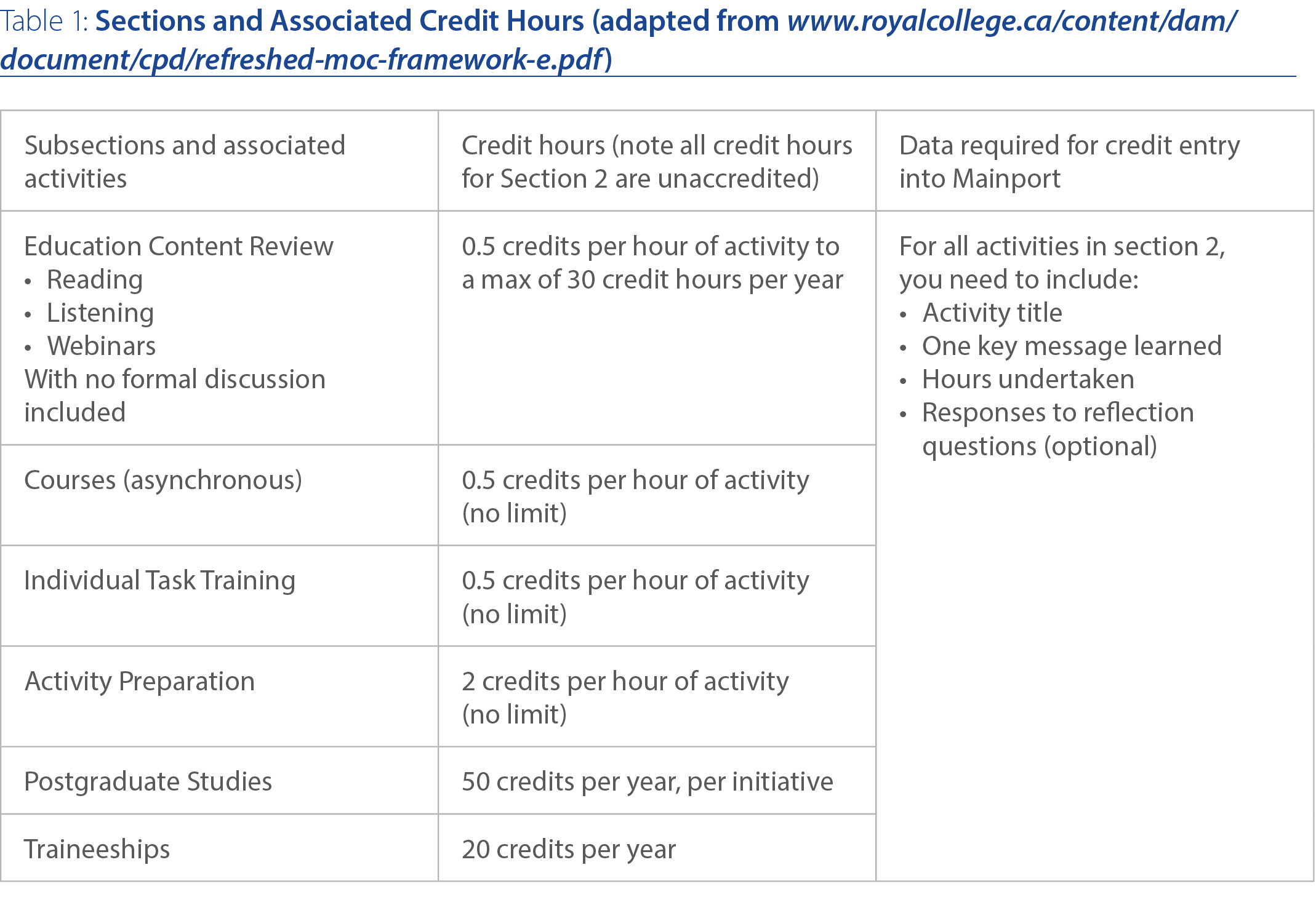
RCPSC Maintenance of Certification (MOC) Section 2 consists of these subsections: Educational Content Review, Courses (asynchronous), Individual Task Training, Activity Preparation, Postgraduate Studies (fellowships, Master’s and PhD), and Traineeships. Each of these sections has specific credit hours associated with it. Table 1 delineates the credit hours associated with each section.
Educational Content Review includes all types of review activities, including reading journals (online or hard copy), listening to podcasts, and reading educational journals or watching webinars. These activities include those that do NOT have a formal discussion opportunity. If these activities include a formal discussion opportunity, the hours should be claimed under the appropriate subsection of Section 1.
Courses include all individual or group courses (online, hard copy) that do not have a formal discussion included in the course. If the course includes a formal discussion opportunity, they should be recorded in Section 1.
Individual Training Courses include any and all training to improve technical skills. If the training is to improve non-technical skills, then those hours should be claimed under Courses in either Section 1 or Section 2, depending on whether there is a formal discussion opportunity included.
Activity Preparation was previously titled Personal Learning Projects prior to January 2024. This subsection includes learning activities undertaken in preparing to complete a task. These tasks may include (but are not limited to) addressing a clinical or academic question; preparing to deliver a teaching session or presentation; preparing education for patients, families or communities; preparing a manuscript (book, chapter, article); preparing a grant application; addressing an administrative or systems-related question; and creating an oral or written exam question for submission. The time committed to the preparation of these tasks counts for 2 credits per hour of time. This does not include the actual time spent completing the actual task (i.e., teaching a session or doing research).
Postgraduate Studies include studies for a Master’s or PhD degree or a formal subspecialty fellowship (must be structured and formally organized). A RCPSC fellow may claim 50 credits per year per initiative. For example, if a RCPSC fellow is completing a master’s degree and the program of study takes 1.5 years they can claim a total of 100 credits over the two (calendar year) cycles.
Traineeships are formal learning opportunities that include learning objectives, a learning plan, receipt of formal feedback from a mentor or supervisor related to the learning objectives, and acknowledgement of completion of the activity, and are based on a previously identified professional learning need. Activities in this subsection can be claimed for 20 credits per year regardless of the number of traineeships or the length of time taken to complete them.
“It appears that if I focus my attention on activity preparation and ensuring that I record my “courses” appropriately between Section 1 and Section 2, I can be sure to maximize my learning and participation in my MOC, remarked Dr. Joint. Once you start tracking progress as you go, things become much easier.”
Elizabeth M. Wooster, B.Comm, M.Ed, PhD(c)
OISE/University of Toronto
Research Associate,
School of Medicine, Toronto Metropolitan University
Raheem B. Kherani, BSc (Pharm), MD, FRCPC, MHPE
Clinical Associate Professor, University of British Columbia
Director, Intensive Collaborative Arthritis Program,
Mary Pack Arthritis Program
Clinician Investigator, Arthritis Research Canada
Division Head, Rheumatology, Richmond Hospital
Rheumatologist, West Coast Rheumatology Associates
Madelaine Beckett, MD, FRCPC
Adult Rheumatology Resident,
University of British Columbia
Douglas L. Wooster, MD, FRCSC, FACS, DFSVS, FSVU, RVT, RPVI
Professor of Surgery,
Temerty Faculty of Medicine, University of Toronto
Clinical Professor,
School of Medicine, Toronto Metropolitan University
|