Winter 2025 (Volume 35, Number 4)
CPD for the Busy Rheumatologist
Maintenance of Certification:
How Do I Begin to Navigate This Refreshed Approach?
By Elizabeth M. Wooster, B.Comm, M.Ed, PhD(c); Raheem B. Kherani, BSc (Pharm), MD, FRCPC, MHPE; Madelaine Beckett, MD, FRCPC; and Douglas L. Wooster, MD, FRCSC, FACS, DFSVS, FSVU, RVT, RPVI
Download PDF
Dr. Aki Joint, a member of the Canadian Rheumatology Association, remarked, “There is a new Royal College Maintenance of Certification (MOC) Program with different guidelines. However, I am uncertain about what they are.”
Beginning January 1st, 2024, the Royal College of Physicians and Surgeons of Canada changed the requirements for its MOC program. This refresh was based on feedback from Royal College fellows and health care professionals. The MOC is an integral part of the process to remain a fellow in good standing of the Royal College of Physicians and Surgeons of Canada and meets the requirements of most medical regulatory associations (https://www.royalcollege.ca/en/cpd/moc-program). Additionally, residents may also earn credits and transfer up to 75 credits into their first 5 year cycle, with a maximum of 25 credits from each of the three sections (https://www.royalcollege.ca/en/cpd/moc-program). Each five-year cycle runs from January 1st to December 31st.
In 2024, the following changes were made to the MOC:
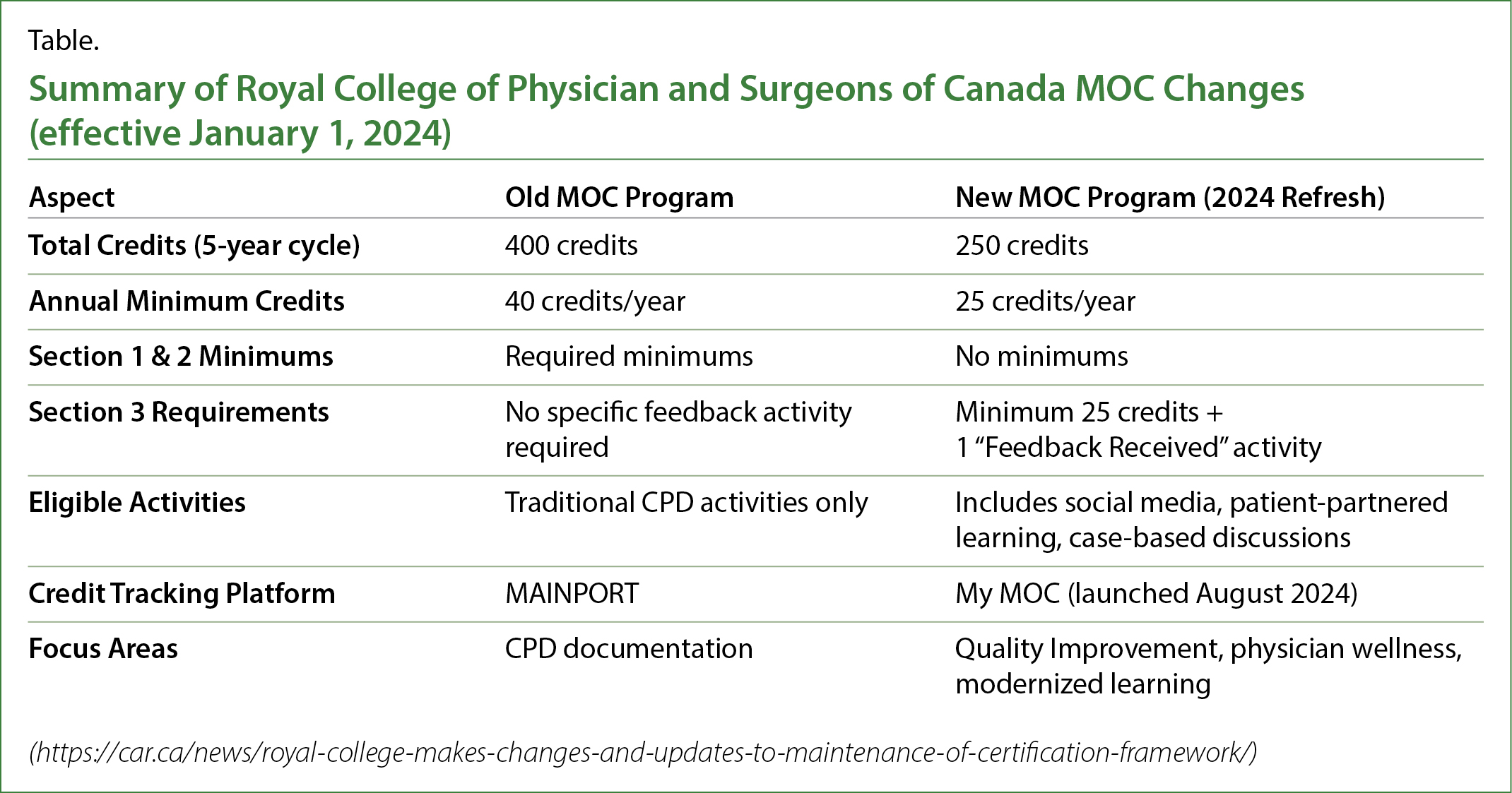
1) Each 5-year cycle now requires a total of 250 credit hours
2) A minimum of 25 credit hours per year
3) A minimum of 25 credit hours from Section 3
4) One activity must be completed in the “Feedback Received” category within Section 3 (no minimum credits required for this activity). For more information, please see RCPSC MOC Framework (https://www.royalcollege.ca/en/cpd/moc-framework.html).
The three sections of the MOC are:
1) Section 1: Group Learning activities include all knowledge, skills and abilities developed through partner, group and team learning experiences. All activities must include an interactive component with opportunities for discussion. This section’s name is unchanged; and social media, case-based discussions, resuscitation courses and patient-partnered learning have been added.
2) Section 2: Individual Learning includes all knowledge, skills and aptitudes acquired through self-directed, independent learning. This section’s name remains unchanged; and courses, individual task training, and patient-centred activity preparations have been added.
3) Section 3: Feedback and Improvement involves activities where feedback is received, feedback is given or a quality improvement initiative is undertaken. This section’s name has been modified to explicitly recognize quality improvement activities. Some examples of additions are quality improvement initiatives, adverse event reporting, and coaching activities.
“I am now clearer about the changes to the categories,” says Dr. Joint. “But how do I report the credits I have earned for the January 1st, 2025, to December 31st, 2025, year?”
Changes have also been made to the process by which Fellows are required to log their MOC credit hours and the module through which they do so.
1) MAINPORT has been changed to MyMOC and can be accessed at MyMOC (https://www.royalcollege.ca/en/members/moc/dashboard.html).
2) For Sections 1, 2 and 3 the following information must now be included:
a. activity title
b. one key message learned
c. your responses to reflection questions (optional)
3) For Section 3 activities a brief description of what will be changed in your practice must also be included.
“I now have learned about the changes to the MOC program. With my cycle ending in December 2026, my earlier credits carry over unchanged, and I can enter my new learning activities into the new portal. I should make sure my residents know about these changes, as they can carry over some of their learning activities credits to their MOC.”
Elizabeth M. Wooster, B.Comm, M.Ed, PhD(c)
OISE/University of Toronto
Research Associate,
School of Medicine, Toronto Metropolitan University
Raheem B. Kherani, BSc (Pharm), MD, FRCPC, MHPE
CRA Education Committee Past Chair,
Program Director and Clinical Associate Professor,
University of British Columbia
Director, Intensive Collaborative Arthritis Program, Mary Pack Arthritis Program
Clinician Investigator, Arthritis Research Canada
Division Head, Rheumatology, Richmond Hospital
Rheumatologist, West Coast Rheumatology Associates
Richmond, British Columbia
Madelaine Beckett, MD, FRCPC
Adult Rheumatology Resident
University of British Columbia
Douglas L. Wooster, MD, FRCSC, FACS, DFSVS, FSVU, RVT, RPVI
Professor of Surgery,
Temerty Faculty of Medicine, University of Toronto
Clinical Professor
School of Medicine, Toronto Metropolitan University
|
-EN-v2.gif)

-EN-v1.gif)